Review – Railsea

Railsea has been compared to Herman Melville’s Moby Dick, but it’s really just China Miéville’s take on an adventure story. Its philosophies, the hunt, the unknown, and the need for answers and exploration of our origins drive this novel.

Shamus Yes ap Soorap (Sham for short) is the youngest crew member of the Medes, a mole train on the hunt for a big catch on the great Railsea. He has dreams of working salvage — finding new things, old things, and alien things. What he actually does is assist the doctor of the Medes and bring water to the men and women who are working to break down the moles they hunt into oil, bone and skin. The captain of the Medes, Naphi, is on the hunt for a mole — a legendary ivory-colored mole called Mocker-Jack. She believes, as other mole train captains do, that capturing Mocker-Jack is her destiny.

When the Railsea leads the crew of the Medes to an old wreck, Sham goes with the crew to investigate and finds something he hopes to make his very own piece of salvage. Instead, he hands over the small camera memory chip to the captain. The images it contains lead Sham and his captain in essentially the same direction with different outcomes — Sham is led to two children of now dead-explorers, and the captain is led to new, never-before-conceived hunting grounds. Naphi’s dreams of bringing down Mocker-Jack, her famed ivory-colored mole, now seem within reach.

What Miéville does that I absolutely love is create places so familiar, yet at the same time so strange. He creates a land that the crew is afraid to step on for fear of dying. This world of safe land among animal-prowled soft dirt is both alien and accessible at the same time. It’s a world of dirt, but he makes you see it as a world of water — deep and unsafe water at that. Out in the Railsea, it’s the tracks that keep everyone safe, and you have no choice but to believe that’s the absolute truth of this world.

This is also a book filled with characters you’ll care about and fear for in a world poised to attack. Sham is young, untested, naïve, and trusts people too easily. He never knew the fate of his parents, and when he has the opportunity to bring closure to two children whose parents have died, he sets out to do just that, unaware of the implications his actions may bring. His pet, an injured daybat he nursed back to health and named Daybe, is a stalwart friend and more than just a silly little bat. Daybe is fearless, with crazy loyalty to young Sham, and is one of the book’s most memorable characters.

I’ve read several of Miéville’s books, and he’s now on the list of authors from whom I anxiously await books. No matter the topic, a book by Miéville is one that I want to read. He has an ability to take our world, warp a few elements, twist a few basic beliefs, and make it something so new and strange. These new worlds don’t stop existing simply because the book is closed. His worlds and stories stay with you long after the end.

As a side note, I’ve seen this book described as a young adult novel. It’s really much more than that, and much more than just a re-telling of Moby Dick. It’s about dreams and adventure in a world we want to get to know better. And isn’t that why we read? China Miéville makes these worlds we crave possible. In fact, you should be reading Railsea now.

In addition to this blog, I also do reviews for The Book Reporter website. The above review was done for the Book Reporter which can be found here. The book was provided to me by the publisher.

Railsea
By China Miéville

Publisher: Del Rey

ISBN: 9780345524522

4.5 stars

And now I’m back

Actually, I got back a few days ago but it’s taken some time to re-adjust. After 17 days on vacation, coming home is wonderful; going back to your normal life isn’t so wonderful. I do have reviews to post but I thought I’d share photos instead because I’m still feeling slightly lazy when it comes to writing. I read three books while on the road — Railsea by China Mieville, The Seventh Gate by Richard Zimler, and finished The Name of the Wind by Patrick Rothfuss — but this was a vacation spent outdoors and lugging books in a pack with water and food didn’t happen often.

First stop, San Diego for a wedding. While waiting for the festivities to begin, we made a stop at Balboa Park. They have a fantastic museum called the Museum of Man that we got to spend time in. I recommend it if you’re going to be out that way.

On the way out of San Diego, we stopped at Cabrillo National Monument.

We moved on to Sequoia National Park which is simply the most beautiful place I’ve been so far in this life. The pictures don’t do it justice and it was impossible to take a photo of tree that’s so tall you almost fall over backwards trying to look up at it. These trees are the most amazing things I’ve seen and I want to share every photo I took just to convince you of this but I’m going to pick one and one only. You really have no idea how difficult this is. 🙂

Kings Canyon was next. It’s a little known national park tucked behind Sequoia National Park that has some of the most amazing views. It’s difficult to get to, the drive in is crazy, there’s only one road in and out, but it’s worth it. I thought Sequoia was beautiful with the lush forests and fantastic views but Kings Canyon made me rethink that statement, for only a minute, but it was a long minute. To be safe, I’d say it was a tie.

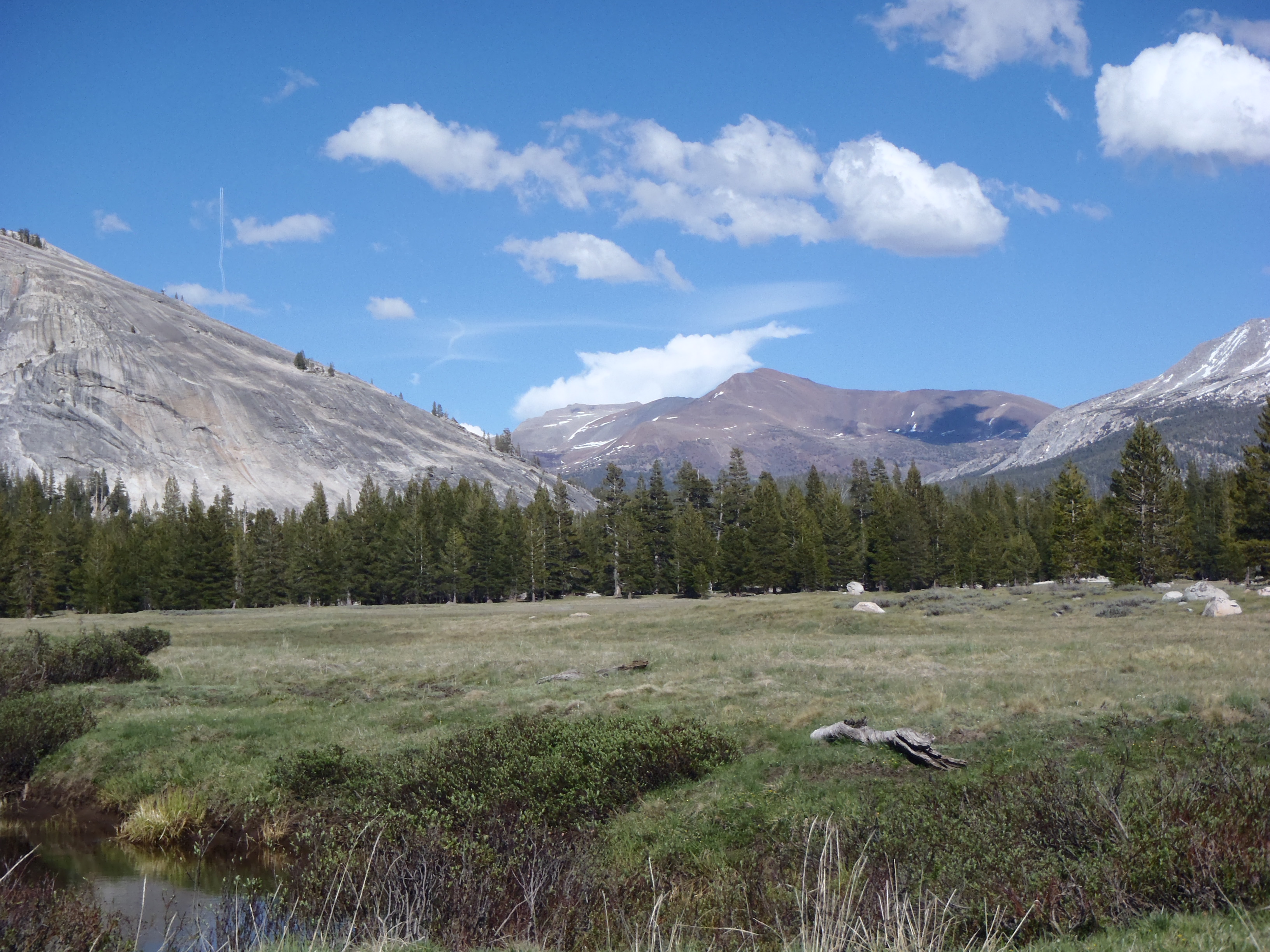
Then came Yosemite. Now, Yosemite is a beautiful place but a crazy place too. The valley floor is crowded, you can walk up a paved path to almost everything there, but once you get off the floor and start to explore the mountains, you really see the beauty of this place. For this I give you Toulemne Meadow which is a most peaceful place to lose yourself. It’s also the place where we saw a snow storm in June. Yes, you read that correctly — a snowstorm in June. It was scary and awesome all at the same time. We made it off the mountain without a problem but it will forever be a crazy memory. This was taken the day before the storm.

We made our way to Napa after Yosemite and oddly I didn’t take any photos. Could have been all the wine…

The final stop, San Francisco. Really, it seems I only took a picture of the gate in Chinatown so here it is. We were there to visit friends we haven’t seen in a few years and it’s a city we know (and love) and honestly, after that many days of taking photos, I gave up.

That’s the short re-cap. I’ll be back to posting reviews probably tomorrow.

Excuse me for a moment

I meant to post something last week but life intervened, and well, now I’m getting around to it thanks to some free wifi.

I’m taking a short break and plan to be back with news of all sorts of  books read, places seen, mountains conquered. You know, that sorts of thing.

So, enjoy those books!

Review – The Winter Sea

I’m an historical fiction junkie and while I don’t read general romance books, when it’s tossed with some historical fiction, I’m all about it. That’s what Kearsley does so deftly in this book — she takes what should be a simple story about a woman writing a book and makes it about the lives of the women she’s writing about. This is a book where I wanted every possible happy ending to happen.

The Winter Sea begins in present day Scotland with an author, Carrie McClelland, working on a new novel about the Jacobites and a failed invasion. She finds inspiration while visiting a friend who lives in Scotland and decides to stay on and rent a small cottage near Slain’s Castle which plays a part in the story she’s telling. The cozy cottage fits her needs well and the writing comes along at an incredible pace for her. Carrie begins making friends with many of the locals; particularly the sons of the man she’s renting the cottage from. All seems to be going incredibly well, except the research. Research has always been a part of her work but she finds herself not needing it so much in this book. Carrie begins to wonder if the past is starting to intrude a bit on the present for her.

Time slips never bother me, especially in historical fiction. In The Winter Sea I particularly enjoyed this because we got to meet so many interesting characters. The second story, the story within the story if you will, only takes place in the time slip, and is centered in 1708 Scotland. It’s here that Sophia Paterson, a young woman running from a bad situation, is taken in by a Countess (she is made out to be a distant relative) and finds love, and a life she never expected.

When I said I wanted the proverbial happy ending above, this is where I wanted it. Without giving much away, there were parts of Sophia’s story that were so sad but understandable. Really, I adored this character and wanted her to be just as happy as Carrie. It was not to be but that doesn’t change how much I enjoyed this book.

I’ll admit that I’m easily seduced by a Scottish setting but it was the wonderful characters that immediately sucked me in. This one lived up to my expectations and beyond. While there were two distinct stories being told here, they never felt separate, they were integrated so well I didn’t feel as though I was missing anything when the perspective switched. I loved the family history that Kearsley wove throughout the story for Carrie, which was part of the reason it worked so well. Tying the fictional author to her ancestral characters was a nice touch.

This was my first of Kearsley’s books. I’m just sorry I waited so long to pick this one up.

The Winter Sea

By Susanna Kearsley

Source Books

4.25 stars


Red Seas Under Red Skies Read Along – Week 4

I wasn’t able to participate last week because of work but this week I’m back. Next week may be a gamble depending on whether I can find a wifi signal in San Diego, CA so I wanted to make sure I got in as much as possible this time around. Kinda sad I might miss the last go around because this has been a great read along. Anyway, on with it!

Thanks to Ashley at SF Signal for last week’s questions and nrlymrtl from Dark Cargo for this week’s questions.

Week 3

1. Locke and Jean’s ability to find themselves at the center of a serious mess seems unparalleled. At this point, do you think that Stragos will get the return he expects on his investment in them?

He might but Locke and Jean will be extracting a price of their own as well, that’s my guess at least. Then again, they might end up at the bottom of the sea. These two seem to find attract every single bit of trouble any place has to offer. But if they didn’t, it wouldn’t be so much fun to read would it?
2. Merrain’s activities after our boys leave Windward Rock are interesting. What do you think her plans are?

I’m beginning to wonder who she’s really working for.
3. Does anyone know why having cats aboard the ship is so important?

Eat mice, scare rats?
4. The word “mutiny” creates a lot of mental pictures. Were you surprised? Why or why not?

No. I didn’t see this little boat ride going well for Locke, Jean maybe, but not Locke. He’s a good actor but he’s an actor. Someone was going to notice the man didn’t know what end of the boat he was on at some point. I’m surprised it took as long as it did.
5. Ah, the Poison Orchid. So many surprises there, not the least of which were the captain’s children. Did you find the young children a natural part of the story?

I was really surprised by the kids, mostly because there haven’t been any in the story except in flashbacks to mini Locke and Jean. It definitely humanizes Zamira and why she’s so cautious.

In a way, it is a natural part of the story though. Why wouldn’t someone have kids even a pirate?
6. Jean is developing more and more as a character as we get further in to the book. Ezri makes the comment to him that “Out here, the past is a currency, Jerome. Sometimes it’s the only one we have.” I think several interesting possibilities are coming into play regarding Jean and Ezri. What about you?

Oh yes.
7. As we close down this week’s reading, the Thorn of Camorr is back! I love it, even with all the conflict.  Several things from their Camorri background have come back up. Do you think we will see more Camorri characters?

Again, oh yes.


Week 4

1. I was much relieved when Jean and Locke made up, which started with Locke’s gesture of a cup full of honesty with Cpt. Drakasha. Do you think that was hard for Locke? Or was he using this bit of honesty like any other weapon in his arsenal to get what he wants in the end?

Double edged question. I think he needed to be honest for Jean because he respects and loves him. And I think there may have been a slight (oh so slight) amount of guilt mixed in with that respect and love that made Locke understand that he needed to lay the cards of the table. But, yes, he always thinks of himself first and what he can get out of it so even by telling the truth he was still using the situation to his advantage.

That makes Locke sound awful but I don’t see him that way, it’s just who he is and what he does, even when he isn’t lying.
2. The Parlor Passage: We still don’t know Locke’s true name, but whatever was in that mist does. What do you think it is?

It’s driving me nuts that I don’t know his name! Not that there’s anything wrong with Locke which I think is a fabulous name but I want the real one.

I’m not too sure I want to think of what’s in that mist but whatever it is, is what creepy is made of. Then again, maybe it’s nothing and the fog is really just a chemical or a drug that causes hallucinations.
3. There was an interesting section of the book that started about where Locke assisted Drakasha in selling the Red Messenger; he put on the persona of Leocanto Kosta and used the alias Tavras Callas and then Drakasha was still thinking of him as Ravelle….. Did using all those various aliases in such a short amount of time have your mind spinning a little? Do you think Lynch did this on purpose to give the reader a sense of Locke’s mind?

I was surprised to see Tavras Callas back. First, because I sort of think of him as a scheme from the first book, and two, it seems risky to bring someone like that back even in a part of the world he isn’t know. I keep thinking that’s going to come back and bite him. It does make you wonder about Locke’s head though and how full it is of disguises and personalities that I questioned if Locke even knows who he was. I don’t think of Locke in anyway negative but the fact that he can switch his personality on and off made me wonder about his mental health.
4. That was a sweet little kiss between Cpt. Zamira and Cpt. Jaffrim at the end of the Captains’ Council. Do you think they have some history, or is it just innocent flirting that’s been going on for some time?

Can you say baby daddy?
5. Jean and Ezri. Cue dove-cooing and little winged hearts with sparkles. Do you think Jean will stay with the Poison Orchid or that Ezri will leave her ship to pal around with Jean and Locke?

She’s the newest member of the Gentleman Bastards! She is. I know it.

And if she doesn’t leave to stay with Jean I’m going to be so upset. Finally, something nice for Jean. Don’t ruin it!
6. What is Utgar up to? What are his motivations?

It took me a second to realize what was going on here and I don’t like it. I have no idea what he’s up to but it’s all bad. That I know.
7. So last week we hashed over that Merrain killed some of Stragos’s guards on Windward Rock. But when Jean and Locke visit him, he doesn’t mention it. What is up with that?

I don’t get what’s up with her although I’m sorta digging her style. She’s like freelance killer, freelance spy, freelance I will tell you all nothing and play you all against each other.

Or, Lady Gentleman Bastard number two.
8. This week’s section left us where the book began – Jean pointing a crossbow at Locke’s throat. Do you think Jean knows who sent these crossbowers? Is he on their side? Is it a clever ploy to get him and Locke out of this predicament? Did you find it excruciatingly hard to stop here?

It’s a way to get them out of the mess because I can’t believe that Jean would turn on Locke, even though he is a huge pain in the ass.

And this was the worst place ever to stop this week’s reading! Worst. Place. Ever!

Now that my answers are posted, I’m going to start reading again.

Review – Let’s Pretend This Never Happened (A Mostly True Memoir)

There are books I feel I never adequately describe and think it would be best if I just wrote in ginormous font:

READ THIS BOOK! NOW! GO!


Let’s Pretend This Never Happened is going to be one of those books so keep staring at those big letters.

Among my friends, The Bloggess is a bit of a hero, mostly because she brought home a giant metal chicken to ring the doorbell. If you don’t know about Beyonce, go here. You see, we have an ongoing joke about chickens which I’m going to decline to talk about because it’s only funny to my friends. Needless to say, we all read her blog and to me, she’s one of the funniest, and honest, writers out there.

This book, which I have been looking forward to for a very long time, was just as funny as I hoped it would be, and in some ways even crazier than I thought. I laughed out loud, giggled, and then cried because I was giggling so hard. I was also slightly grossed out — deer sweaters and vomit. (ick) The chapter on infertility was heartbreaking and real. It’s not something people want to talk about but it’s a part of life and the road to parenthood and she acknowledged it as that.

Being able to laugh at ourselves and the strange lives we all lead is a big part of the book. We all enter adulthood in a convoluted manner and even, and especially, the embarrassing parts that shape us in our struggle to become the people we are. You have to embrace it all.

What are some of the funniest parts?

Well, obviously, Beyonce. The chapter – And That’s Why You Should Learn to Pick Your Battles. What starts as an argument over towels with her husband ends up in the purchase of a giant metal chicken.

The chapter where she describes numerous ways to photocopy body parts and how not to hide those photocopies and or websites you shouldn’t be looking at from human resources – The Dark and Disturbing Secrets HR Doesn’t Want You to Know. Needless to say, any hopes and dreams I ever had of working in HR are now gone. Gone I tell you!

So what do you do when your dog dies? Please don’t answer that it’s only a segue into the chapter – Honestly, I Don’t Even Know Where I Got That Machete: A Comic Tragedy in Three Parts Days. Let me just say we all need a friend to help fend off vultures and help put a beloved dead dog to rest. And the vultures are not metaphorical in this instance, I mean real vultures. This also means I will never be leaving my urban digs for rural Texas.

There’s a chapter called Making Friends With Girls that really made me smile. I’m fortunate in that I have some really wonderful women in my life, even the ones that are clear across the country and in places I don’t get to visit often. But, on the whole, I’m not the type of person that makes friends easily. I’m a nice person and all, I’m just shy. Reading another person talk about making friends was a shining spot in my day that meant I wasn’t the only one that found it hard to talk to people. Even when you know you aren’t the only one, it’s nice to hear it.

I could go on but I prefer not to give the whole book away because you should read it. It’s one of the funniest books I’ve read in such a long time. And of course, that doesn’t adequately describe the book at all (see above).

Also, The Bloggess is a person you should be reading here too. I want to keep talking but I feel I’ve already gone overboard on the mushy, gushy review part so, carry on. Oh, and read the book!

Let’s Pretend This Never Happened (A Mostly True Memoir)

By Jenny Lawson (The Bloggess)

G.P. Putnam’s Sons, Amy Einhorn Books

ISBN: 9780399159015

4.75 stars

Review – Madame Bovary

Okay, to be clear, this book was not at all what I thought it would be. I was, no lie, expecting torrid sex scenes. Why? I have no idea. I just was. Funny thing is, I don’t read anything even approaching erotica so I’m not sure where this thought came from. Obviously, something was lost in translation for me.

Charles Bovary is a less than ambitious man but he’s a good man. A doctor by trade, he’s happy practicing in a quiet French hamlet. After he starts his medical practice, his mother finds him a wife; an older and rather unhappy woman who dies early on in their marriage leaving Charles the opportunity to find love. He believes he may have found it in a woman named Emma who he met while setting her father’s broken leg. Emma has dreams, the first of which is to get away from her father’s home, so when Charles asks, she agrees to marry him. Married life is agony for her. She has a pleasant home, a husband who cares for her immensely — almost to the point of smothering her — and she has few tangible complaints. What she wants is romance though. After attending a ball, it’s all she can think about and her boring life holds no interest for her. Charles decides that Emma needs a change of scenery and moves the family (a child will soon be born to the couple) to Yonville. Emma soon finds herself entranced by a law student, Léon Dupuis, who seems to return her affection. Appalled by her own thoughts, she refuses to act and Léon soon leaves to finish his degree.

However, when Emma meets Rodolphe Boulanger, all thoughts of propriety go out the window and she gives in to his advances and starts the affair. She wants to run away, but Rodolphe, who has had several mistresses, decides that she is too clingy and breaks off the affair on the morning they’re to leave town together. Shattered by the end of the affair, Emma falls into a deep depression and sickness. When she finally recovers, Charles again tries to re-interest her in life this time believing the theatre will be the answer. It’s here that she once more meets Léon and begins her second affair. Lie after lie build up as do her debts. Emma is incapable of handling the lies or the debts and begins begging others for help, which doesn’t arrive. In a final dramatic act, she deals the only way she can.

At first, I felt sorry for Charles. He was boring but loving. He wasn’t ambitious at all and was happy with his life. He had a beautiful wife and child and a medical practice that provided the necessities of life. But, again, he was boring. Then he tried to pin everything wrong with his wife on a nervous condition which annoyed me and any sympathy I may have had for the clueless husband vanished. Emma on the other hand, doesn’t exactly deserve any praise. She wants everything, expensive things, is constantly bored, obsessive, and refuses to see any good in her life. She’s always looking for the next best thing. And it must be said, she’s a horrid excuse for a mother. Emma is interesting though and the reason to keep reading because every other character in this book is flat. Toward the end though, when the proverbial dirty laundry is aired, everyone is at fault in some way or another and it’s hard to have any sympathy for any of the characters.

My book had two additional sections at the end about the book itself, trials, bannings, etc. I didn’t read them. I think I wanted to look back on the book from my own perspective and not the perspective of a scandalous 19th Century trial discussing the need for a stricter moral code. Also, I think it would have made me upset and I enjoyed this book and didn’t want it to be marred.

So, back to my first paragraph — the sex. It’s there but it’s off screen. There’s kissing, there’s heavy petting, but shall we say, not what I was expecting considering the ruckus this book caused. Then again, that was back in the day. I don’t want to get into a discussion of morals, really, I’m the last person, but it’s an interesting part of this story and while I never felt lectured to, obviously, Emma is a lesson. But her character is more than simply a woman having an affair, she’s a woman unhinged but somewhat deserving of some understanding, even if it’s just to understand her depression better.

Madame Bovary

By Gustave Flaubert

Penguin Putman

3.75 stars


Review – A Wrinkle in Time

A Wrinkle in Time is a book I wish I would’ve read as a child, although as an adult I was still pretty impressed with it. I just kept wonder what my small self would’ve thought of it.

Meg Murry has trouble in school. She’s a smart kid, especially when it comes to math, but she has a temper and lands her in trouble more often than not. She has a lot to worry about too — her father, a government scientist, has been missing for months and it’s taking a toll on the Murry family. During a late night thunderstorm, Meg sneaks down to the kitchen for a snack and finds her little brother, Charles Wallace, already there. Soon their mother joins them and then the eccentric new neighbor, Mrs. Whatsit, shows up unexpectedly. After an eventful night, Meg’s next day is shot and she can’t wait to get home from school. Later, Meg and Charles Wallace head off to visit Mrs. Whatsit when they run into her classmate, Calvin O’Keefe. After some questions, Charles Wallace decides Calvin can come with them and the three set off. They meet the neighbors, Mrs. Whatsit, Mrs. Who, and a third Mrs. W who announces that they can help the kids get Mr. Murry back. The three children are then transported to another planet to help their father escape.

When I was reading, I got semi-wrapped up in the story and didn’t really think about the heavier aspects of it until I’d finished. One, the science fiction aspect is huge and I would have loved to have heard about wormholes before I discovered Star Trek. Another time… There is a strong religious element although, again, this one didn’t hit me until I realized that some of the quotes Mrs. Who was rattling off were bible passages. The Whatits are also, and maybe I’m remembering this wrong, at one point referred to as angel-like. Not being a religious person, these things usually pass over my head in most books.

Character wise, I loved Meg. She’s feisty, doesn’t like to hear she’s wrong, and happy to be a little different than most. She fights back when IT on the planet of Camazotz tells her he can make her happy just like everyone else. She tells him she doesn’t want to be like everyone else. Yep, an “Ahh,” moment for me. Meg has her quirks, but overall, she’s such a sweet character that I could see my small self really liking her. Although, Charles Wallace gave me the creeps. He’s a child of about five but he’s more like 30 and I found him to be a tad much at times. I wanted to like him, but his speaking like an adult one minute and being on the verge of a temper tantrum the next was weird.

The adult version of me was happy to see that L’Engle didn’t back off when it came to tough issues for what are essentially children — a missing father, school problems, family issues, etc. As child me, I probably never would have noticed that and simply thought this was just their life. Interesting how that happens. Oh, the years, they bring perspective.

Has anyone out there read the entire series? Is it worth it? I’m thinking of continuing but worried the rest might not live up to this one.

This was a BHA Book Club read and you can find more comments here. It was an April 2012 pick but I’m behind on reviews so this is a May review instead.

A Wrinkle in Time

By Madeleine L’Engle

Farrar, Straus and Giroux
ISBN: 1429915641

4 stars